
 Summary: Following Analox Military Systems’ recent contract win to supply Norwegian Navy submarines with carbon monoxide monitoring systems, MOD DCB caught up with Sales and Marketing Director Vicky Brown to find out what lay behind the company’s latest success.
Analox Military Systems (AMS), based in Stokesley, North Yorkshire, recently won an order to supply the Norwegian Navy’s six submarines with life-saving carbon monoxide monitoring equipment, Analox also supplies to the British, US, Dutch and Canadian navies.
Sales and Marketing Director Vicky Brown said: “It took persistence and patience to win the contract. We have been working with the Norwegian Navy since 2000. When I joined the company they were one of the first customers I actually met, to discuss a submarine escape analyser called the Sub MkIIP. They have been using this product for the last thirteen years.
“So we kept in touch, kept having chats about what their issues were and what challenges they were facing. One of the main issues that every submarine operating nation faces is finding a way to detect carbon monoxide on the boat. A domestic carbon monoxide alarm isn’t suitable, as it is actually more sensitive to hydrogen than it is to carbon monoxide and submarines contain hydrogen.
“We talked to the customer, researched different techniques of detecting carbon monoxide at the levels they needed, through various technologies, and then we found something that looked like it would do the job. We did some trials of the equipment with the Dutch and Norwegian navies, continued research in the background and made some improvements to the systems.”
The hard work was by no means over, however, as Analox then had to wait for the Norwegian Navy to gather a budget and release a tender for an analyser. Once the tender was released, Analox spent three months working on it before submitting it in September 2012, entering into contract negotiations this year and signing the contract in June.
When working in foreign military sales, Ms Brown identifies the tendering process as the most complex aspect of business.
Ms Brown explained: “The main challenge is understanding the customer’s purchasing process – finding out how the customer nation goes about it; what the customer needs to buy in-country and if they need in-country support; and finding out their terms and conditions and national standards. You can get lost in reels of information about what the process is in the first place before you even think about what the product has to do. Add to this the preparation you have to do in the UK to make sure you can actually sell the product, and get a UK export licence.
“That is a challenge for a company of our size, where we are a small team, so we all just try to get stuck into it and do the best we can.”
Helping the team along is Contracts Manager Kerry Sturman, who uses her legal background to interpret the customer’s terms and conditions and outline the actions needed to meet them. She also ensures Analox is compliant with all export requirements.
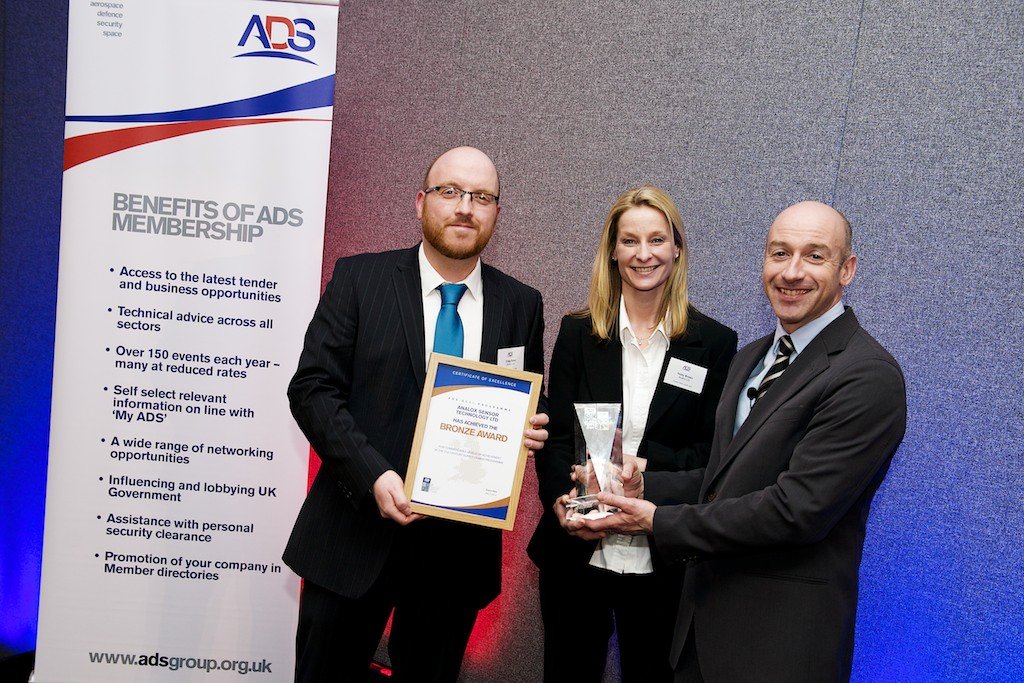
This thorough approach to manufacturing is what won Analox a bronze award at the Q2 2013 SC21 Supply Chain Awards.
Ms Brown said: “It was great to have recognition, not just of our manufacturing standard, but of the whole of the business.
“It is really just the start of our continuous business improvement programme. It is nice that we have the bronze award and it is good that our customers can see this level of quality being produced by the company, but on a daily basis we are seeing the results of the improvements we make, so hopefully next year we will be able to move from bronze to silver.”
Growth is at the heart of Analox, a company which started off simply supplying commercial diving air analysers.
Ms Brown commented: “The company was founded in 1981 by Alan Harbottle who spotted a need in the commercial diving industry for analysers; where divers are working in saturation diving systems at pressure they need these systems to show that the air is safe to breathe.
“He had an office in Guisborough in Cleveland and as the business grew he started making and selling the systems himself instead of selling other brands.
“Analox Military Systems was set up two years ago, as the result of military clients’ needs being very different from those of our commercial clients. The main reason for this is that the number of decision makers involved in the military supply chain is much greater than in the commercial sector, so the time it takes to make the sale is longer. The longevity of the system required is also greater, as is the through-life support. Plus the requirements of export controls are different.
“We recognised these differences and changed the way we staffed and resourced this branch of the company, in setting up AMS.”
Once the military division of the company was formed it wasn’t long before it gained business overseas.
Ms Brown added: “We started in the commercial diving industry thirty-odd years ago. It is a niche market, but also a very international one, with a lot of activity in the North Sea and the Gulf of Mexico.
“Our focus then became about identifying customers’ needs, then offering the products and making sure they matched and exceeded those needs.”
One of the ways in which Analox does this is through their bespoke design service, whereby customers describe their requirements and Analox creates products to suit them.
Ms Brown explained: “Invariably, with austerity, more nations are trying to get off the shelf products, but we do still get bespoke requests, say for safety critical equipment. We create this through the use of different hardware and software design – using an internationally recognised standard called IEC61508.
“We’ve completed various projects where we have had to miniaturise things, or scale them up. For instance, we had a project where we worked in conjunction with a company called Divex to develop a re-breather, like the kind divers carry, to fit on a decompression chamber, as the vessel couldn’t carry enough gas to operate the chamber. In conjunction with their equipment we automatically control the pressure of the chamber and the gas delivery to the chamber to make sure that the vessel can carry enough gas to safely decompress divers for the whole time that they are out.”
This flexible approach has won Analox contracts with the Norwegian, Dutch and US military, among others.
Further explaining Analox’s success, Ms Brown said: “You need to have a good product, do your research, know your process and find a good partner on the ground.
“I am very lucky to work with a very interesting group of customers – it keeps every day different.”